AI Readiness
How Strong Firms Build AI Readiness from the Workflow Up
The firms that succeed with AI do not start with AI. They start with workflow design, build standardization, layer automation, and only then — with a stable operating foundation underneath — integrate AI. The AI Readiness Ladder is the structural progression that separates firms with AI capability from firms with AI subscriptions.
AI readiness is a structural progression, not a technology purchase. The AI Readiness Ladder defines four stages: Workflow Design, Process Standardization, Targeted Automation, and AI Integration. Each stage builds on the one before it, and skipping stages produces the failures documented throughout this cluster. Strong firms build up the ladder methodically. The result is not just AI adoption but AI that works — reliably, at scale, within an operating model designed to support it.
How firms build genuine AI readiness — the structural progression from workflow design through AI integration that produces sustainable capability rather than scattered experimentation.
Founders, COOs, and strategic leaders in accounting firms who want a practical framework for building AI capability rather than accumulating AI tools.
This article synthesizes the diagnostic insights from the preceding nine articles into a prescriptive playbook — the four-stage path that strong firms follow to make AI work.
Executive Summary
- AI readiness is a four-stage structural progression — the AI Readiness Ladder — that moves from Workflow Design through Standardization and Automation to AI Integration. Each stage creates the foundation the next stage requires.
- The preceding nine articles in this cluster document what happens when firms skip stages: AI fails without workflow maturity, amplifies existing problems, produces unreliable results from poor data, and creates review burden without structured handoffs.
- This article synthesizes those diagnostic insights into a prescriptive framework: the specific actions, decisions, and structural investments each stage requires before the firm can reliably move to the next.
- Most firms overestimate their position on the Ladder because they measure readiness by tool adoption rather than structural maturity. The assessment questions at the end of this article help leadership determine where the firm actually stands.
The AI Readiness Ladder
The AI Readiness Ladder is a four-stage framework for building AI capability in accounting firms. It is not a technology roadmap — it is an operating model progression that creates the structural conditions under which AI tools produce reliable value.
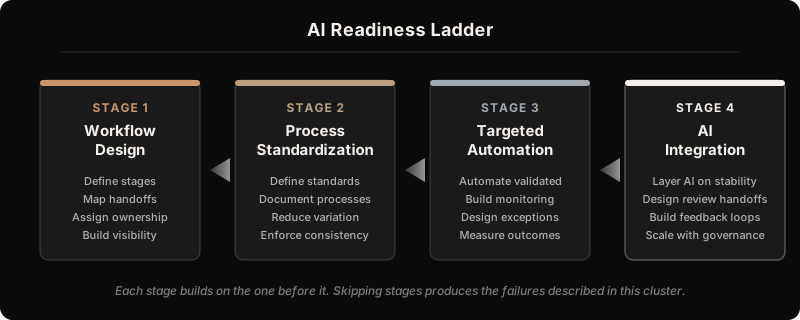
The Ladder reflects a structural reality: AI tools do not create operational discipline. They require it. Every stage in the Ladder builds a layer of discipline that the subsequent stage depends on. Workflow design creates defined stages and handoffs. Standardization creates consistent processes within those stages. Automation accelerates the standardized processes. AI integration layers intelligent capability onto the automated, standardized, well-designed foundation.
Firms that skip stages experience the failures documented in the preceding articles of this cluster. Firms that follow the progression build AI capability that is sustainable, scalable, and genuinely productive.
Stage 1: Workflow Design
Workflow design is the foundation. Without it, nothing above works reliably.
What this stage builds: Defined stages for how work moves through the firm. Clear ownership at each stage. Explicit handoff criteria between stages. Visible transitions that leadership can monitor. The goal is not perfection — it is intentional design that replaces the informal, improvised workflows that most firms operate with.
What this stage requires: The firm must map its core service delivery processes — not how they are imagined but how they actually function. This means observing how work moves, identifying where it stalls, documenting who does what at each stage, and defining what "complete" means before work transitions. This is the structural foundation described in detail in our analysis of how strong firms design handoffs that scale.
What "done" looks like: The firm can describe, in writing, the stages of its core service delivery. Each stage has a defined owner. Transitions between stages have explicit criteria. Leadership can see where work sits at any point without asking someone. Work does not stall in unnamed gaps between stages because the gaps have been identified and designed away.
Why firms skip this stage: Because workflow design feels like overhead when the team is busy with client work. The firm has always operated with informal workflows — why formalize now? The answer is that informal workflows cannot support anything beyond informal operations. Every subsequent stage — standardization, automation, AI — requires the structural clarity that only intentional design provides. As documented in the analysis of why AI fails without workflow maturity, firms that skip this stage find that AI has nowhere reliable to operate within.
Stage 2: Process Standardization
Once workflows are designed, the processes within each stage must be standardized.
What this stage builds: Consistent ways of performing core tasks across all team members. Defined naming conventions, file structures, and data entry standards. Documented procedures that any team member can follow. Reduced variation that creates the predictable patterns AI requires.
What this stage requires: The firm must define reference processes for each core service, document them, train the team, and enforce consistency. This is organizational change, not documentation — it means telling experienced professionals that their individual approach will align with a firm-wide standard. The dynamic described in why process standardization is an AI prerequisite and the flexibility that standardization actually creates are both relevant here.
What "done" looks like: The same task is performed the same way regardless of which team member does it. Data quality is consistent because entry conventions are standardized. A new team member can learn the firm's process from documentation rather than from shadowing a colleague. The firm's processes are consistent enough that an external observer — or an AI tool — could predict how any task will be performed.
Why firms skip this stage: Because standardization requires leadership authority and change management. It is easier to let each team member continue their own approach than to define and enforce a standard. But data quality depends on standardized input, and AI tools cannot function on data that varies by preparer. Skipping standardization guarantees that AI will produce inconsistent results.
Stage 3: Targeted Automation
With standardized processes running on designed workflows, the firm can begin automating.
What this stage builds: Automated execution of validated, standardized processes. Monitoring infrastructure that catches errors before they compound. Exception handling that routes non-standard situations to human judgment. Measured outcomes that demonstrate automation value.
What this stage requires: The firm must select which standardized processes to automate first, build automation on the validated process (not the legacy informal approach), design monitoring and error detection, and measure results. The cautions documented in why automation without design creates faster chaos apply directly: automation amplifies whatever it is applied to, so the underlying process must be sound.
What "done" looks like: Priority workflows are automated with monitoring. Error rates are tracked and improvement trends are visible. Exceptions are routed to human judgment through defined paths. The automation produces measurable time savings or quality improvement that justify the investment. The team trusts the automation because it operates on a process they designed and validated.
Why firms skip this stage: Because AI seems to offer a shortcut. "Why automate the simple stuff when AI can handle the complex stuff?" The answer is that AI integration without automation creates a hybrid environment where some work is manual, some is automated, and AI output enters an inconsistent operating model. Automation creates the consistent, monitored environment that AI integration requires.
Stage 4: AI Integration
With a designed, standardized, automated operating foundation, the firm is ready for AI.
What this stage builds: AI tools operating within structured workflows. Defined review handoffs between AI output and human oversight. Quality criteria specific to AI-generated work. Feedback loops that improve AI effectiveness over time. Governance that ensures responsible AI use.
What this stage requires: Tool selection based on diagnosed workflow needs. Review handoff design as described in why AI creates new review burden. An adoption pathway that moves from experimentation to strategy. And the governance infrastructure described in the capstone article on why AI governance fails without operating discipline.
What "done" looks like: AI tools are producing measurable value within specific workflows. Reviewers have defined quality criteria for AI output. The firm can demonstrate operational improvement attributable to AI. AI errors are captured and the system improves over time. The firm has AI capability — not just AI subscriptions.
Why this stage works: Because every prerequisite is in place. The workflows are designed, so AI output has somewhere structured to go. The processes are standardized, so AI operates on consistent data. The automation is validated, so AI integrates into a monitored environment. The review handoffs are defined, so AI output is evaluated efficiently. The firm did not buy AI readiness. It built it.
Common Mistakes at Each Stage
Stage 1 mistake: Mapping the ideal workflow instead of the actual one. Firms document how work should move rather than how it actually moves. The designed workflow looks good on paper but does not reflect operational reality. Map what is, then design what should be.
Stage 2 mistake: Standardizing everything at once. Firms attempt firm-wide standardization across all services simultaneously. The organizational change required overwhelms the team. Start with one service line, prove the model, then expand.
Stage 3 mistake: Automating before validating. Firms go directly from designed process to automation without a manual validation period. Edge cases that manual execution would reveal are discovered only after the automation is producing errors at scale. Always run the designed process manually first.
Stage 4 mistake: Deploying AI without review handoff design. Firms deploy AI tools and discover weeks later that senior staff are overwhelmed by review volume because nobody designed the AI-to-human handoff. Design the review stage before deploying the production tool.
Assessing Where Your Firm Stands
- Stage 1 check: Can the firm describe its core service delivery workflows with defined stages, clear ownership, and explicit handoff criteria — in a document, not just in people's heads?
- Stage 2 check: Is the same task performed the same way regardless of which team member does it? Are naming conventions, file structures, and data entry standards defined and enforced?
- Stage 3 check: Are priority workflows automated with monitoring, error detection, and exception handling? Can the firm measure the automation's operational impact?
- Stage 4 check: Are AI tools producing measurable value within specific workflows, with defined review handoffs, quality criteria, and feedback loops that improve performance over time?
- Honest assessment: Most firms that have purchased AI tools are at Stage 1 or Stage 2 on the Ladder. Having AI subscriptions does not mean the firm is at Stage 4. The Ladder is defined by structural maturity, not technology investment.
- Starting point: Identify the earliest incomplete stage and start there. Building Stage 3 on an incomplete Stage 2 produces the same fragile results as building Stage 4 on an incomplete Stage 3. The foundation must be solid before the next level is added.
Strategic Implication
The AI Readiness Ladder is not a model of aspiration. It is a structural description of what must be true before AI produces reliable value. Firms that follow the progression build AI capability that compounds over time. Each stage creates infrastructure that the next stage leverages, and the cumulative effect is an operating model that absorbs new AI capabilities as they emerge — because the structural readiness is already in place.
Firms that skip stages cycle through AI tools, blame vendors, and conclude that AI is overhyped. They are not wrong that their AI investments underperformed. They are wrong about why. The tools were not the constraint. The operating foundation was.
Firms working with Mayank Wadhera through DigiComply Solutions Private Limited or, where relevant, CA4CPA Global LLC, use the AI Readiness Ladder as the diagnostic and implementation framework for AI readiness work. The engagement begins with an assessment of where the firm stands on the Ladder, identifies the structural gaps at the current stage, and builds a progression plan that moves the firm up the Ladder methodically. The goal is not to sell AI tools. It is to build the operating foundation that makes AI tools work — because the firms that win with AI are the ones that built readiness before they bought capability.
Key Takeaway
AI readiness is a four-stage structural progression: Workflow Design, Standardization, Automation, AI Integration. Each stage builds the foundation the next stage requires.
Common Mistake
Skipping stages — jumping to AI Integration without the workflow design, standardization, and automation that make AI output reliable and absorbable.
What Strong Firms Do
They follow the Ladder methodically: design workflows, standardize processes, validate and automate, then integrate AI onto a stable foundation.
Bottom Line
The firms that succeed with AI did not buy readiness. They built it — one stage at a time, from the workflow up.
Frequently Asked Questions
What is the AI Readiness Ladder?
The AI Readiness Ladder is a four-stage progression for building AI capability in accounting firms: Stage 1 is Workflow Design (defining stages, handoffs, and ownership), Stage 2 is Process Standardization (creating consistent processes across teams), Stage 3 is Targeted Automation (automating validated, standardized workflows), and Stage 4 is AI Integration (layering AI onto a stable operating foundation). Each stage builds on the one before it, and skipping stages produces the failures that most firms experience with AI.
Why do firms need to start with workflow design before AI adoption?
Because AI output must enter the firm's operating model — and if that model has undefined stages, unclear handoffs, and no visibility, the AI output has nowhere reliable to go. Workflow design creates the structural foundation that determines whether AI output can be absorbed into how work actually moves through the firm. Without it, AI produces output that enters an unstructured environment and creates confusion rather than efficiency.
How long does it take to move through the AI Readiness Ladder?
The timeline varies by firm size and current maturity, but most firms can complete Stage 1 (Workflow Design) in two to four months, Stage 2 (Standardization) in three to six months, and Stage 3 (Automation) in two to four months for priority workflows. Stage 4 (AI Integration) is ongoing as AI capabilities evolve. The key insight is that many firms are already partially through early stages — the Ladder helps them identify where they are and what comes next.
Can a firm skip stages on the AI Readiness Ladder?
No — and attempting to skip stages is the most common cause of AI adoption failure. Firms that jump directly to AI Integration without workflow design, standardization, and automation end up with AI tools operating in an unstructured environment. The preceding articles in this cluster document what happens at each skip: AI fails without workflow maturity, amplifies existing problems, and produces unreliable results when data quality and process standardization are absent.
How does a firm assess which stage it is currently at?
Assess against each stage's requirements: Can the firm describe its core workflows with defined stages and handoffs? (Stage 1 complete.) Are those workflows standardized across teams with documented processes? (Stage 2 complete.) Are the standardized workflows automated with monitoring? (Stage 3 complete.) If any stage's requirements are not met, the firm is at or below that stage — regardless of whether AI tools have been purchased.
What role does leadership play in moving through the AI Readiness Ladder?
Leadership is essential at every stage. Workflow design requires authority to define how work moves through the firm. Standardization requires authority to establish firm-wide standards that override individual preferences. Automation requires investment decisions and change management. AI integration requires strategic direction about where AI adds the most value. Without leadership authority and commitment, the firm stalls at whichever stage requires organizational change.
Is the AI Readiness Ladder a one-time progression or an ongoing cycle?
It is both. The initial progression moves the firm from its current state through each stage to AI integration. But AI capabilities evolve continuously, and the firm's workflows must evolve with them. The Ladder becomes a cycle: as new AI capabilities emerge, the firm returns to workflow design to define how the new capability integrates, standardizes the new process, validates the automation, and integrates. Mature firms operate this cycle continuously.
Related Reading
- Why AI Governance Fails Without Operating Discipline
- Why AI Fails Without Workflow Maturity
- Why Most Firms Overestimate Their AI Readiness
- How Strong Firms Design Handoffs That Scale
- Why Standardization Creates Operating Flexibility
- Explore Diagnostic Frameworks
- Browse Free Guides
- Take a Strategic Assessment